In this blog you’ll learn:
- Why cloud migration, usually pursued for cost savings, so often leaves agencies unable to predict what they will actually spend.
- How AI workloads, data egress, and consumption-based pricing drive cloud costs in ways that surface long after the migration decision is made.
- What senior leaders should weigh, including data sensitivity, demand volatility, and governance, before committing a workload to the cloud or keeping it on-premises.
In conversation after conversation with law enforcement and intelligence agency leadership, one theme stands out: cloud migration is most often pursued in the name of cost savings, but many are growing increasingly concerned about their inability to accurately predict spend. They are not alone. In its 2026 State of the Cloud Report, Flexera found that managing cloud spend is now the top cloud challenge, cited by 85 percent of organizations, with wasted spend climbing to 29 percent for the first time in five years.
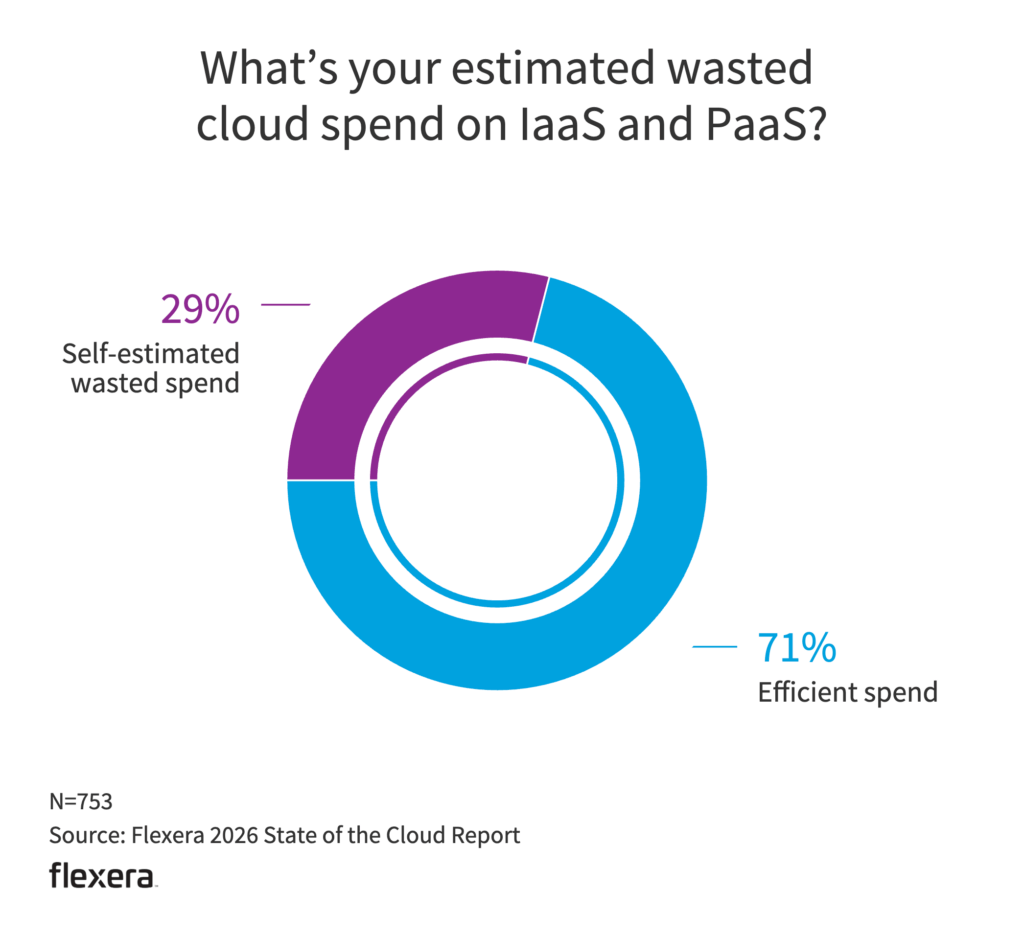
New numbers like these may lead agencies toward the conclusion that cloud has become overpriced. That misses the point. The real advantage of cloud is flexibility: the ability to scale capacity up or down quickly in response to demand. But that same flexibility is what makes the bill unpredictable, because spending now rises and falls with usage rather than holding to a fixed line.
The surge in AI workloads has recently become a significant driver of that unpredictability, and understanding why means looking at how the technology actually works, not just how it is budgeted. For that reason, I have asked my colleague Sean Thibert, JSI’s Senior AI Product Manager, to weigh in throughout this article on where those AI costs actually come from and how agencies should think about them.
The Cost Question
Why does cloud spending behave this way? Part of the answer is that cloud pricing is not static. Providers face rising business costs of their own, including data center expansion, power, cooling, hardware refresh cycles, network capacity, security investments, and ongoing support, and those pressures eventually flow into customer pricing. At the same time, cloud cost models can punish organizations that do not actively monitor usage. Small design choices, excess storage, idle instances, data egress, and poor query patterns can all create unexpectedly large bills. That is why cloud spending so often feels unpredictable: the provider is managing its own cost base while the customer is exposed to consumption-based charges that can escalate quickly if usage is not tightly governed.
SEAN THIBERT, SENIOR AI PRODUCT MANAGER, JSI
Rob is describing the visible bill. With AI workloads, the costs that matter most are the ones you can’t see. An AI search box is relatively cheap on its own. What you are actually buying is everything behind it: preparing the data, re-indexing it every time records change, and the backend work a single natural-language query sets off. That spend grows as your data and query volume grow, and it lands in the recurring operating budget rather than the one-time migration line.
A closer look at cloud pricing structure reinforces the point. On Google Cloud, moving the same gigabyte of data costs $0.02 within North America but $0.14 to South America — a spread driven entirely by where the data is going, not by anything the agency controls. A single charge category sounds small until you remember that cloud bills are built from thousands of these line items, each with its own rate, tier, and destination logic. Even a change to one part of the bill can materially affect organizations that move a lot of data or depend on always-on services.
Cloud costs are rarely driven by one dramatic line item. They are driven by the accumulation of many smaller charges that become difficult to control without disciplined governance.
SEAN THIBERT, SENIOR AI PRODUCT MANAGER, JSI
AI model pricing itself is now volatile, and that is also easy to miss at procurement time. GitHub Copilot raised token costs roughly 9x for certain model multipliers earlier this year, and workflows built on a stable token economy suddenly cost a multiple of what they used to. Expect more of it. The adoption subsidies frontier labs (OpenAI, Anthropic, Google, etc.) offered over the past two years are collapsing under profit mandates, and that pressure flows straight to anyone running cloud-hosted AI search and analytics.
Customers facing these increases do have choices, such as moving to a different provider or renegotiating terms, but switching is rarely straightforward. Long-term contracts often carry early-termination fees, migrating large data volumes incurs high egress costs and weeks of downtime, and reconfiguring workflows demands technical expertise that many organizations simply do not have on staff. The alternatives exist on paper. In practice, most customers absorb the hikes rather than endure the disruption.
Steady and predictable workloads can also tell a different story than the marketing usually suggests. If an organization runs a stable environment with hardware that stays well utilized over time, on-premises infrastructure can be less expensive in the long run, particularly when recurring cloud charges accumulate month after month. Storage-heavy or always-on systems, exactly the profile of many mission systems, deserve especially careful evaluation before anyone assumes migration will produce direct savings.
Governance by Design, Not by Discovery
Moving to the cloud is not just a technical swap. It is a shift that requires moving away from a ‘project-first’ mentality toward a ‘governance-by-design’ approach. Treat cloud migration as a simple lift-and-shift and you are essentially leaving the door wide open for fiscal and operational chaos. You have to clearly define how data access is authorized, monitored, and capped before you start migrating workloads; otherwise, that much-celebrated elasticity is just a fancy term for an unmanaged expense report. Every unrestricted query and every unmonitored resource turns into a bill, and without automated guardrails you are relying on people to catch mistakes the system should be preventing automatically.
The real key is establishing a disciplined governance layer to regulate data retrieval and compute usage from day one. Depending on the size and complexity of the operation, that might mean identifying high-risk activities, including cross-region egress, full-table scans, and model-heavy queries, and baking programmatic circuit breakers, query throttling, and identity-based access controls into the baseline environment. Embedding these considerations into procurement and planning, rather than discovering them after the first quarterly bill, is how cloud infrastructure remains a predictable, scalable asset rather than an unmanaged source of technical debt. The maturity of any cloud strategy ultimately shows up in one place: the ability to maintain rigorous policy enforcement that balances service delivery with predictable costs.
SEAN THIBERT, SENIOR AI PRODUCT MANAGER, JSI
With AI workloads, the fastest way to inflate a bill is to leave model usage ungoverned. If any team can route any query to the most expensive model available, costs rise in ways that are hard to see until the quarterly bill. The controls that prevent this are straightforward: limit which models can be used for which tasks, tag spending so it traces back to a team, and set budget alerts that flag overruns before they accumulate. These guardrails belong in the contract at procurement time. They are easy to defer, and the agencies that defer them are the ones that get surprised.
Where Cloud Genuinely Helps
The strongest case for cloud is rarely the raw price point. It is the ability to scale. Capacity can be expanded quickly when demand rises and reduced just as quickly when it falls, without waiting on procurement cycles, hardware delivery, installation, or data center preparation. That changes how an organization plans, budgets, and responds to real-world conditions.
This matters most where demand is uneven or uncertain. Seasonal operations, public-facing systems with traffic spikes, temporary projects, testing environments, and surge or emergency-response workloads all benefit from infrastructure that can adjust without permanent overinvestment. In those cases, the value is not only financial. It is operational, because the organization gains speed and room to adapt.
SEAN THIBERT, SENIOR AI PRODUCT MANAGER, JSI
That speed advantage is sharper than usual right now, because the hardware can be genuinely hard to get. GPU availability is limited across most distributors, lead times for high-end accelerators run into months, and retrofitting an on-premises environment to host them (power, cooling, networking, space) is a project in itself. An agency trying to scale an AI capability quickly often can’t get the hardware in time, regardless of budget. That is one case where cloud is the more practical near-term option.
Why Many Still Consider On-Premises Advantageous
On-premises systems continue to make sense in a wide range of situations. Some agencies prefer them because they offer direct control over hardware, network design, data location, and long-term asset planning. Others maintain on-premises environments because they have already made substantial capital investments, have specialized performance requirements, or operate workloads that simply do not change enough to justify cloud elasticity.
There is also a governance dimension. Cloud environments can become expensive when services are provisioned faster than they are managed. Poor visibility, overprovisioning, idle resources, and weak cost controls can eliminate the savings most decision-makers expect at the start of a migration. Moving to the cloud without disciplined financial management does not reduce spending; it simply shifts it from one category to another, often less visibly.
SEAN THIBERT, SENIOR AI PRODUCT MANAGER, JSI
One question I see procurement teams ask too late is, unless the contract terms are negotiated and verified, there is no automatic guarantee that a third-party frontier lab will not use your data to train its models. For agencies handling sensitive information, that is a very serious issue. Ask it before signature, not after.
And Back to Security
The cost conversation cannot be separated from security. As I have noted in a previous article, cloud migration introduces a different security posture, not just a different pricing model. The same elasticity that makes cloud attractive can also increase exposure if identity controls, segmentation, logging, configuration management, and access governance are not tightly enforced. Put differently: the organizations that move fastest to the cloud without a mature security model often discover the real cost is a weaker security posture, not just a larger bill.
The Real Decision Point
For most agencies, the core question is not whether cloud is universally cheaper. The better question is whether the organization values elasticity enough to justify the pricing model and management discipline that cloud requires. If demand is volatile, growth is uncertain, or speed matters more than ownership, cloud often offers a strong business case.
If demand is stable, infrastructure is already in place, and systems can be kept highly utilized, on-premises may remain the more economical option over the long run. That is why so many mature IT strategies now take a hybrid approach, placing variable or rapidly changing workloads in the cloud while retaining stable or sensitive systems on-premises when that better supports cost, control, or performance objectives.
On-premises infrastructure is like owning equipment sized for the busiest day of the year. Cloud is like renting additional equipment only when conditions require it. Ownership is more economical when usage is steady. Renting is more practical when needs change often.
What to Take Away
For large law enforcement and intelligence organizations, the cloud-versus-on-premises question is rarely a binary one. It is a portfolio decision, made workload by workload, against a clear-eyed view of what each option actually costs over a five-year horizon, not what it appears to cost in the first procurement cycle. The agencies getting this right share three habits: they govern cloud spend with the same discipline they apply to physical assets, they assume model and transfer pricing will move against them and plan accordingly, and they treat the choice of where a workload lives as a decision that should be revisited every year, not signed once and forgotten.