Investigations involving financial crime rarely begin with a complete picture.
An analyst may start with a few account numbers, a confidential informant, a company name, a wallet address or a single communication. The difficult part is turning that initial fragment into a clearer network of the people, entities and activity connected to it, and determining what to pursue next.
Often, the information needed to answer those questions already exists. Banking records, suspicious transaction or activity reports (STRs/SARs), corporate filings, location data, device evidence, blockchain activity, and open-source intelligence (OSINT) can each add another piece to the investigation. But these sources rarely arrive in compatible formats or systems that let investigators analyze them together.
That creates two roadblocks:
- Time. Information requests across institutions and jurisdictions can take weeks or months, while assets and actors continue to move.
- Visibility. Even when the data is available, important relationships can remain hidden when each source is analyzed mostly in isolation.
For investigators, the consequence is significant. A partial trail can stay partial. A connection buried across two datasets may never be noticed. Analysts can spend valuable time finding, reconciling, and interpreting information instead of determining what it means and where to look next.
Financial Evidence Can Open the Door
Financial data can reveal much more than where the money went. It can provide a lead into the network behind it.
Europol’s analysis of 821 of the EU’s most threatening criminal networks found that 86% use legal business structures to facilitate their operations and conceal criminal activity. As criminal networks become more financially complex, financial records increasingly provide a valuable starting point for understanding who is involved, what structures they use, and where the money is moving.
For example, an STR/SAR may identify a previously unknown company receiving a series of suspicious transfers. Corporate records connect its director to another entity. Communications place that individual in contact with a known associate, while blockchain activity links an associated wallet to an address already under investigation. No single source establishes the full relationship. It emerges only when investigators examine the information together.
The Fragmentation Dilemma
The more sources an investigation draws on, the more potential intelligence it can uncover, but the harder it becomes to see the relationships between them. Those sources often sit in different systems, in different formats, and sometimes under different authorities. An analyst may need to move between tools, reconcile records and identities, and manually piece together a picture that changes every time another source becomes available.
The challenge has become more pronounced as criminal organizations now operate across traditional banking, cryptocurrency, online platforms and other sophisticated digital channels.
But investigations also extend beyond digital and financial data. Human intelligence (HUMINT) may come from cooperating witnesses, confidential informants, victims, rivals or others who can provide insight into a criminal organization’s structure, relationships, methods and activities. This insight can help illuminate specific people, locations, accounts, devices, shell companies, transactions or communications that warrant corroboration through lawful investigative means.
That relationship works both ways. Investigators may have already obtained financial, digital, documentary, communications, or physical evidence, but HUMINT can help explain its significance within the organization. A payment record that appears innocuous in isolation may take on a very different meaning when an informant provides context about who controls the account, why the payment was made, or how it fits into a money laundering effort.
As these disparate sources accumulate throughout an investigation, bringing them into the same normalized environment can help connect evidence that may initially appear unrelated. Teams can ingest information as it becomes available, building on the context already established and helping reveal connections between new and existing evidence.
That ability to build context continuously lets teams ask more than “What intelligence are we missing?”
They can also ask “What can the intelligence we already have tell us that we cannot see yet?”
Where Investigative Intelligence Comes In
When the trail is incomplete, the best course of action may not be to wait for more information. It may be to make the information already available more useful. Investigative intelligence is the practice of connecting every source surrounding an investigation and examining the relationships across them, rather than treating each dataset as a separate problem. In financial crime cases, that means teams no longer have to interpret financial data in isolation.
Analysts can examine a transaction alongside communications, location data, corporate records, blockchain activity, device evidence, and OSINT. AI-enabled platforms can accelerate this work by helping process the data, identify relevant information, and surface relationships for further analysis, building a more complete and dynamic picture.
That changes how an investigation can progress. Analysts can more easily connect what they already have, follow the relationships it reveals, identify gaps, and quickly determine what data to examine or request next.
The process becomes less about waiting for certainty and more about continuously narrowing the unknowns to keep the investigation moving forward.
How 4Sight Helps Investigators Follow the Trail
4Sight is JSI’s investigative intelligence platform. It helps teams turn fragmented evidence into a connected, usable picture across four stages:
Aggregate
4Sight brings financial transactions, crypto and blockchain data, telephony and IP collection, messaging, location data, surveillance, OSINT, HUMINT, dark web material, and device forensics into one environment, across both live and historical data and structured and unstructured sources.
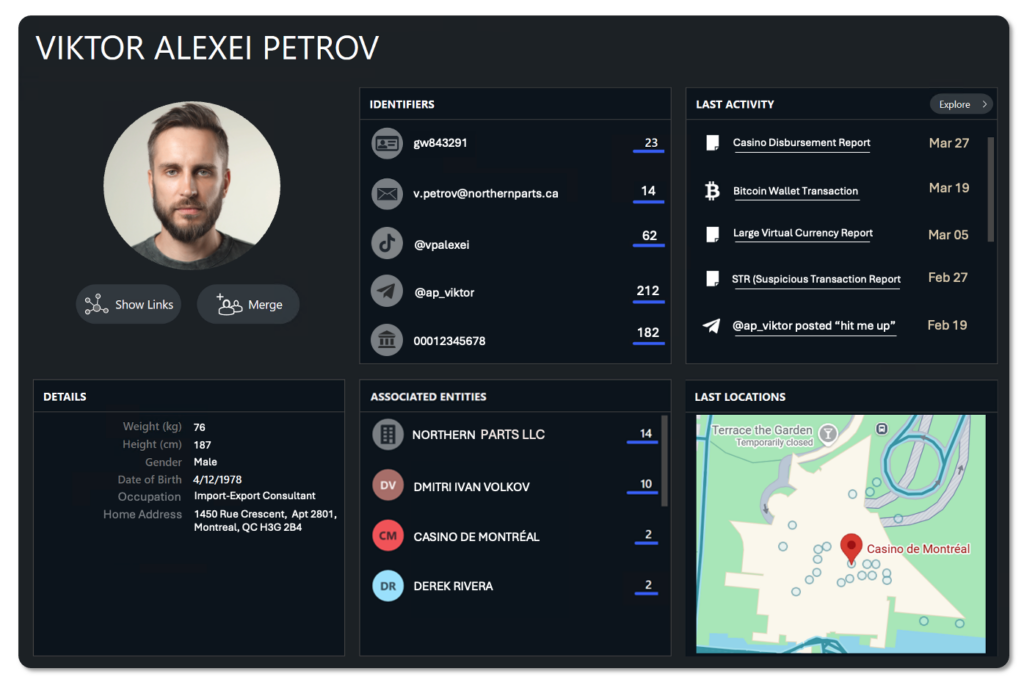
4Sight normalizes all data as it enters the platform, allowing investigators to search, compare and work across sources as part of the same case. That means analysts can have a view of an entity or lead across data types without having to reconstruct the trail manually in separate systems.
Not all material has to come from another system. 4Sight performs lawful collection under the authority an agency already holds, supporting the collection process from standards-based collection through monitoring and reporting, while keeping the resulting intelligence under the same roof.
Augment
Once data enters 4Sight, AI enrichments automatically process the data, turning the raw material into information investigators can work with more quickly.
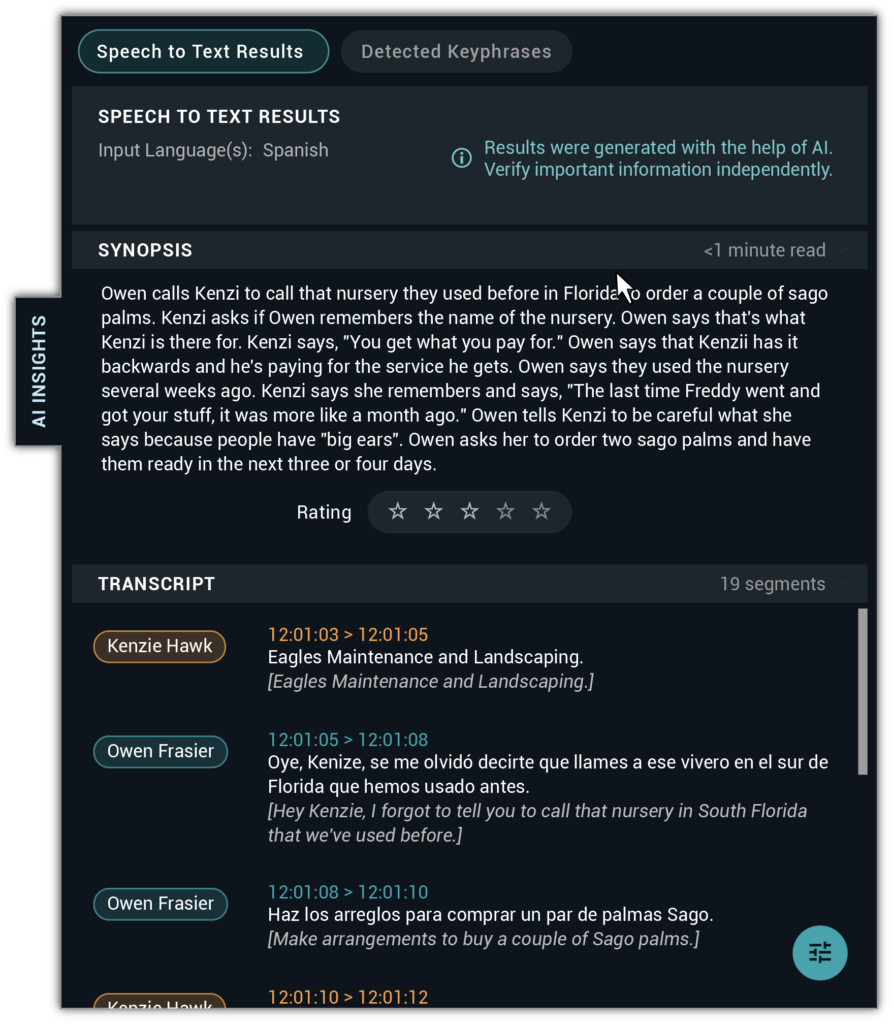
4Sight’s Language Analytics transcribes and translates audio, video and messaging across more than 100 languages, identifies speakers and produces concise synopses highlighting people, places and themes for further review. For images and video frames, 4Sight’s Vision Analytics analyzes visual content, extracts and translates text, and identifies relevant objects or AI-generated material. 4Sight’s Sentry triages incoming data against categories defined by the investigative team and surfaces relevant activity in near real time, with a traceable explanation for each detection.
Analyze
With data brought together and enriched, investigators can map relationships between accounts, intermediaries, people, devices, locations and other entities through interactive link charts, maps, and entity views. A connection that was difficult to see when records sat in separate systems can become part of a larger network exposed by dynamic visualizations.
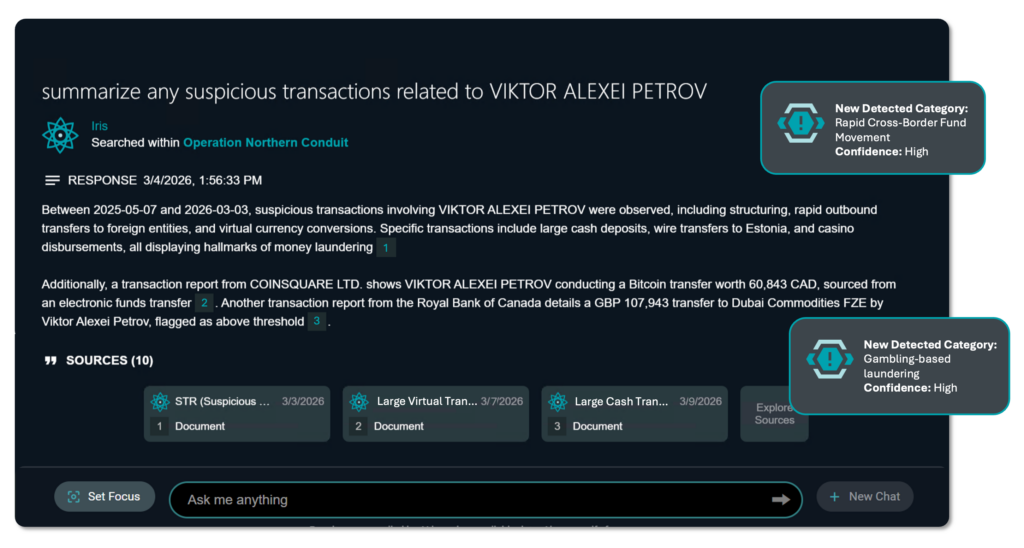
Iris, 4Sight’s generative AI assistant, also allows analysts to interrogate large and complex datasets further using natural language. Its conversational responses and summaries include citations back to the underlying records, allowing analysts to trace an answer to the information that supports it.
Together, these capabilities help investigators move beyond what is already known, uncover relationships they did not know to look for, and determine what to pursue next.
Act
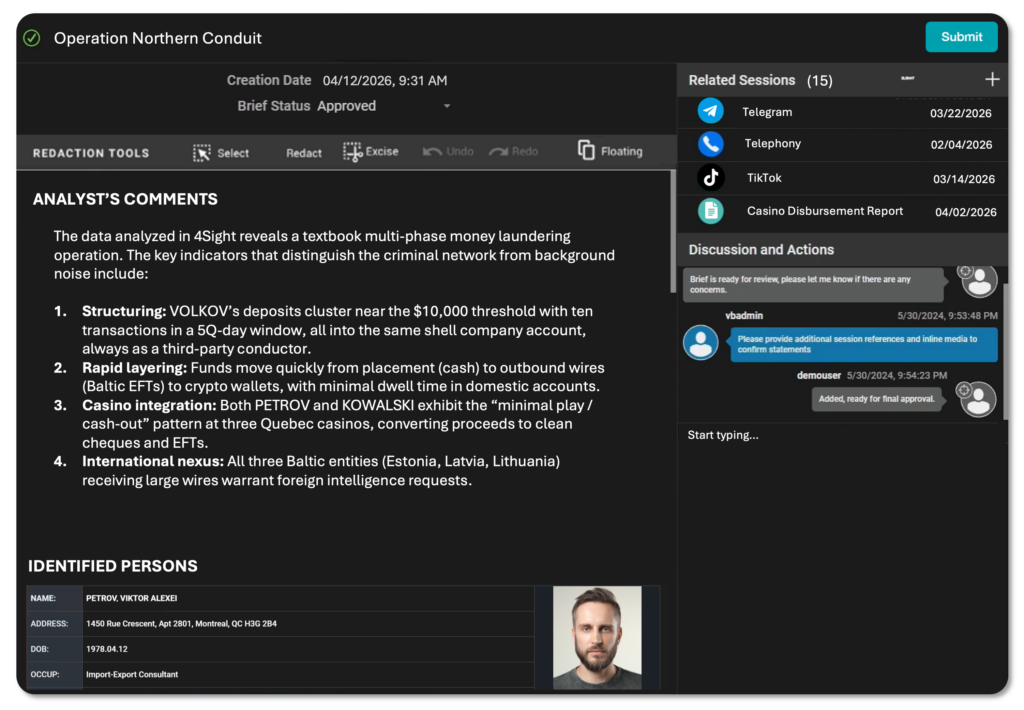
Because 4Sight holds investigative evidence and intelligence in the same environment, teams can move from analysis to reporting, briefing, dissemination, prosecution, or operational response without rebuilding the case multiple times in other systems.
The goal is not simply to have a more complete dataset. It is to help investigators find connections sooner, pursue incomplete trails, and act on what the evidence is telling them while the investigation is still moving.
Evidential Integrity and a Lawful Intelligence Pedigree
For financial crime and other serious investigations, connecting information is only useful if investigators can trust the intelligence it produces.
Since 1979, JSI has focused solely on the development of technology for law enforcement, intelligence, and government agencies. Our foundation in lawful collection has shaped the infrastructure and controls we bring to multi-source investigation, where intelligence needs to remain secure, traceable, and fit for use. Agencies can deploy 4Sight on premises, keeping data and the AI models acting on it within their controlled storage. Permissions govern access, activity is auditable, and analysts can trace every AI-generated output back to the underlying records.
That matters when intelligence moves beyond analysis. Findings may inform operational decisions, support prosecution, or face scrutiny through disclosure and in court. 4Sight builds evidential integrity into the platform, helping investigators understand where information came from, who accessed it, and what evidence supports the finding.
See 4Sight Accelerate a Financial Crime Investigation
The clearest way to understand these capabilities is in context.
Our on-demand demo follows an investigation end to end inside 4Sight, starting with suspicious transaction reports and tracing the relationships they reveal as additional intelligence sources are layered in.
Request the on-demand demo to see 4Sight and its AI enrichments in action.