AI Essentials for Investigative Intelligence | A 6-Part Video Series
Law enforcement and intelligence teams are drowning in data. Today’s investigations include more sources, more formats, and more noise than analysts can reasonably process, especially as staffing and time pressures continue to intensify.
At the same time, the promise of AI is everywhere you turn, and it’s not always clear which capabilities are actually reliable in high-risk investigations. With so much hype, teams need grounded, practical guidance on how AI can support investigative work without adding risk or friction.
This 6-part series breaks down the essentials of AI for law enforcement and intelligence teams, including what can be safely automated, where AI reliably accelerates analysis, how it integrates into real workflows, and the ethical, compliance, and policy considerations agencies must consider.
Hi there, and thanks for joining us in our AI Essentials for Investigative Intelligence video series. My name is Sean Thibert, and I’m a Senior AI Product Manager at JSI, and we built this series for law enforcement and intelligence agency leaders, investigators, and analysts that are facing the new reality of today’s investigations, meaning more data sources, more formats, and far more noise than any team can handle manually.
As criminals adapt their methods, it’s becoming increasingly difficult for teams to make the fast, accurate decisions that are needed to keep pace. Now, at the same time, there’s also a lot of hype around artificial intelligence. It’s often thought of as the fix really for every data problem, but especially in high-risk public safety environments.
The real question isn’t just can AI solve this problem, but it’s more about can it do it safely, reliably, and also fit into a tightly governed, highly scrutinized workflow. And so really that’s the purpose of this series is to break down the core AI capabilities that actually matter for investigative work and actually show where they truly add value and give you a clear understanding of the considerations that should guide every deployment.
So with that foundation, the first part of the series will focus on the core data problem that teams are facing and how AI can help with them. Every year, teams are collecting larger and larger volumes of complex data. Now, this can create real challenges for speed, accuracy, and resourcing.
So let’s break this down in a little bit more detail. First, we have structured data. Now, typically this is the clean, organized information that teams have relied on for years. Things like call detail records, subscriber information, location points, or financial transactions. It’s still essential to every investigation, but there’s just simply more of it, and it’s coming in larger and more detailed batches than ever before.
Then the real complexity comes with unstructured data. Now, essentially, this category has exploded in recent years. Think PDFs, chat logs, social media posts, photos, and hours and hours of video. Now none of this comes in a standard format and not only that, but each piece may contain text content, images, metadata, or even multiple languages. It’s very powerful intelligence, but it’s also incredibly time consuming to review manually.
Now in terms of how data typically comes into these analytical platforms, we do also have batch data. So this is typically again, large dumps of files or exports that arrive all at once from devices from cloud services or seized media. Now this can contain thousands or millions of artifacts in a single package, which can create instant backlogs and be overwhelming for manual review while you’re also trying to cater to that batch data.
On the other end of the spectrum is also streamed data. So this is typically live or near real time feeds from things like CCTV, body worn cameras, sensors and monitoring tools. Now, the pace of this data makes it even harder to process because insights lose value the longer that they sit untouched, and they also typically need enough people to be able to manage and listen to that content in real time.
And lastly, complicating this picture even more is the concept of multilingual data. Transnational threats, global communication apps, and open source channels really mean that you’re increasingly reviewing evidence in multiple languages and dialects, which can create serious challenges in this environment.
Now, when you put all of these things together, you start to get an environment that many of you are facing today. It’s exploding data volumes, it’s increasing complexity and resource constraints that make manual review basically impossible at the pace investigations demand and at the scale of data that you’re starting to collect. And this is why fundamentally new approaches are needed and why understanding where AI can responsibly assist is so important.
So before we proceed, we just want to take a moment here to define what we mean by artificial intelligence. Obviously, it’s a term that gets thrown around constantly, but what does it really mean in practice? So who better to ask about what the definition of AI is than AI itself? So when we prompt ChatGPT to define what it is, it essentially comes out and says that AI is about simulating human intelligence in machines, especially computer systems. It involves learning, reasoning and even self correction, but the ultimate goal is essentially to create systems that can handle tasks that we’d normally associate with human intelligence, things like understanding language, recognizing patterns, solving problems and making decisions.
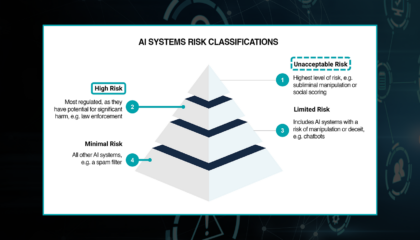
Now, the EU AI Act, which is the world’s first comprehensive AI law that’s working towards shaping its responsible use, effectively defines AI as systems that operate with varying autonomy, adapt after deployment, and generate outputs such as predictions, recommendations, or decisions that influence environments. So if that’s what AI is, what can it actually offer law enforcement and intelligence teams that are grappling with massive amounts of complex data?
Well, we can start, of course, with efficiency. So AI, of course, can drastically reduce the time spent on manual time consuming and repetitive tasks like combing through thousands of chat logs, hours of video, looking for a key object. Instead of spending days on data triage, investigators can now narrow their focus on what matters most next.
We also have resource allocation, so when AI handles the heavy lifting, agencies can effectively deploy their assets where they’ll have the greatest impact. It can even detect and learn from crime patterns to help optimize things like surveillance locations or even predict areas where activity is likely to spike.
Then there’s also advanced investigation capabilities. AI can uncover connections across multiple disparate data sources, links that might take a human weeks to find or never find at all. It can also surface critical insights that are hidden at a scale that manual review simply can’t match.
And finally, reduce decision making bias. Now of course, humans can bring unconscious bias into investigations. And AI, on the flip side, when designed responsibly and trained on diverse data sets, can help to minimize that bias by applying consistent logic to every case. And of course, that’s a double-sided coin and we’ll talk about that in a moment as part of the challenges. But essentially these benefits, just to make it very clear, are not about replacing investigators. They’re about amplifying their capabilities so that you can work smarter, faster and more effectively.
Now, while it does of course bring incredible benefits, AI is not without challenges, especially within a law enforcement context. And these are critical to understand, especially in these high-risk environments.
So first off, explainability is an incredibly important challenge. We can’t treat AI as a black box. If our investigators don’t understand how it works or what its limitations might be or side effects, then you can’t trust the results. Outputs have to be explainable and transparent in order to be useful, and that means ongoing training as the technology evolves.
Next is, of course, accuracy. It’s really important to call us up front that AI is not perfect. It is going to reflect the quality of its training data, and essentially it’s making predictions on the content of what’s coming next based on that training data. So in some cases it can work brilliantly, but in others, it really will not perform very well or very poorly. In some instances, depending on the quality of the input data and depending on the quality of the training data of getting AI to a level of accuracy where the cost benefit makes sense is a real challenge and always something to consider.
And then of course, there’s bias. In fairness, of course, AI learns from historical data. And if that data happens to be biased, then of course the system is going to replicate those biases. For law enforcement, this is a huge concern because decisions are under increasing and intense scrutiny. Diverse representative data and strong governance are essential here to mitigate this challenge.
And finally, misuse. Of course, criminals are also using AI too, whether it’s deep fakes, automated phishing, even evasion tactics. And this means that agencies need to think not just about how to use AI, but also how to defend against its misuse. Now, these challenges don’t necessarily mean don’t use AI. They mean use it responsibly with the right guard rails. And that’s the mindset required for a successful deployment.
Now, that wraps up Part 1 of this video series. So again, in this episode, we’re just keeping it simple. We’re looking at the data problem that teams are up against and where AI fits into it all.
Now in the next parts, we’re going to dive deeper into subfields of AI, starting with natural language processing, so looking at how AI can help teams sift through large amounts of text and audio and pull out the information that actually matters. Part 3, we’ll focus on computer vision, so we’ll look at how you can use AI to make sense of images and videos at scale so that you can spot patterns and evidence much faster. Part 4, we’ll take a look at generative AI, what these tools can and can’t do, and how to use them in an investigative context. Part 5, we’ll look at emerging AI systems, so how these AI capabilities come together in real workflows and what that means for operational impact. And finally, we’ll wrap it up with Part 6, which covers compliance and ethics because again, in high-risk environments, responsible use isn’t optional, it’s mission critical.
So across the series, our goal really is simple. It’s to give you a clear, practical understanding of where AI fits into investigative work and really to help you understand how these technologies can safely support your mission.
So thank you for watching. Really hope to see you in the next part. And again, if you want to learn more about JSI, please do visit our website at jsitelecom.com. Thank you.
What You’ll Learn in Part 1
- How the explosion of structured, unstructured, batch, and streamed data types is complicating data acquisition and slowing investigative analysis.
- How non-linear, multimodal data is making it harder to connect evidence and intelligence into a clear investigative picture.
- How transnational threats are flooding teams with multilingual data, increasing the risk of delays, misinterpretation, and missed intelligence.
- The opportunities (and cautions) artificial intelligence brings to modern law enforcement and intelligence workflows.
What’s Ahead in This Series
This video is only the first installment of our 6-part series on AI Essentials for Investigative Intelligence. In the upcoming episodes, we’ll explore:
- Natural Language Processing (NLP): How it helps process and identify sentiment behind large amounts of text and audio data.
- Computer Vision: Using AI to analyze images and video at scale, surfacing patterns and evidence that are difficult to identify manually.
- Generative AI: What generative AI tools can (and can’t) do in investigative contexts, with a focus on practical value, limitations, and risk.
- Emerging AI Systems: How multiple AI capabilities integrate within real investigative workflows to deliver operational impact.
- Compliance and Ethics: Why responsible, transparent, and policy-aligned use of AI is mission-critical in high-risk environments.
Stay tuned for our next episode on natural language processing.